

News & Events
28th Sunday in Ordinary Time
Posted in News
11th, October 2026
Gospel – Matthew 22.1-14
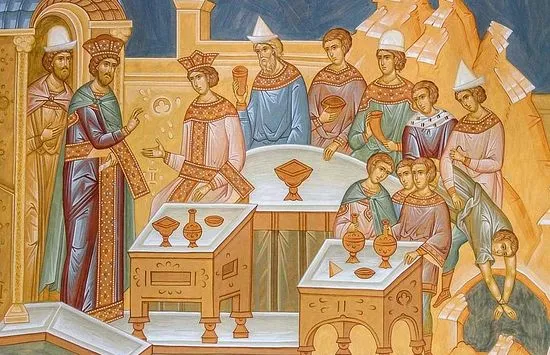
Jesus spoke again to the chief priests, and the Pharisees, in a
parable. A king gave a banquet for the wedding of his son. But when he
sent his servants to call those who had been invited, they would not
come. So, he sent other servants, with the message: “Come now to the
wedding banquet! The cattle and the best calves have been slaughtered,
and everything is ready!” But they ignored the king’s servants, and
went away, to their farms, and to their businesses. Some even seized
the king’s servants, and beat them, and killed them. The king was
furious, and sent his troop to destroy those murderers, and burn their
city. Then the king said to his servants, “The wedding is ready, but
those who were invited are not worthy. So go out into the streets and
invite everyone you find! The servants went out into the streets and
gathered everyone they found, both good and bad, and the wedding hall
was filled with guests. When the king himself came in, he saw that
every single guest had put on the wedding robe except one. The king
challenged him, but he had no reply. And the king had him thrown out
into the night. For even when many are called, not all are finally
chosen.’ The Gospel of the Lord.
_____________________________
Homily
In the Village of Lopinot in Trinidad, at the vacation home which my
parents had, the custom of Parang at Christmas was an expression of
the culture of our people. Musicians and singers would all come out to
sing Christmas carols in Spanish, some of the women would dance, and
they would also be offered food and drink which was never refused. My
mother would bake cakes, and my father would prepare ham and drinks.
Whenever the villagers arrived for parang, it was a moment of great
excitement and happiness. It was also very educational for me because
when the paranderos came to our home, some of the villagers came with
them and my parents accepted them all. I learnt from my parents to
treat all who came to our home in that village as welcomed guests. As
I read the readings for the mass of this Sunday, I remembered the
Christmas vacations in Lopinot and the valuable lessons that I learnt
there.
The parable begins with a King inviting his citizens to the
wedding feast of his son. Jesus is in this parable revealing to us,
his father’s or we can say, God’s plan for the world, a plan that we
can accept or reject. What we are invited to is in fact a celebration
of love and communion with his son, who gave his very life to and for
humanity. This is something so desperately needed by humanity in this
present age. Despite the invitation, those invited showed grave
disrespect for their ruler and decided to occupy themselves with what
I would suppose they thought was more important than the King’s
invitation to his son’s wedding. The disrespect was so grave that some
ill-treated the messengers and even killed them. History has told us
that the age of martyrs is still ongoing. The response of the King to
such blatant disrespect was immediate and terrifying. He sent his
soldiers to destroy those murderers and burn their city. As we apply
thus parable to our present age, we must remember that God invites us
to join with him in recreating the peace and joy of the Garden of
Eden. It is for that reason that the ten commandments were given to
us.
Unfortunately, many of us, very similar to the invites to the wedding
feast, think that we alone have the gifts to bring true happiness to
our world and so we dedicate our time and energy to seeking happiness
for ourselves. The disrespect for God is in fact staggering. The
disrespect for his prophets, even among some religious groups, is
still very much alive. We fall to the temptation of power, prestige
and pleasure. These, my dear friends do not bring happiness. They only
bring division and sorrow to our world and a total loss of happiness
in the world to come. What is important for all of us to recognize is
that God calls all people to be agents of a new and more inclusive
world order. A world order of true justice, of peace, of harmony. A
world order which brings, true happiness and a sense of belonging to
citizens of all countries, something that is so lacking at this time
It must be stated here that Catholics are not the only people called
by God to restore what was lost. Proof of that last assertion is the
history of persons like Mahatma Ghandi, Nelson Mandela, Martin Luther
King and various others who have given their energy and lives to
building a more just and humane world.
As the parable continues, we are introduced to a King who after two
rejected invitations and faced with the disdain of his courtiers sends
out his servants with this instruction. “The wedding is ready, but
those who were invited are not worthy. So go out into the streets and
invite everyone you find!” It is important to state here that,
according to biblical scholars, the translation of streets is not
meant to mean streets of the city. The original term that Matthew the
Evangelist uses refers to the limits of the roads, or those points at
which the city streets end, and the paths begin that lead to the areas
of the countryside, outside the residential areas. In this context,
the reference to streets would include roads to and in the ghettos.
The universe however is lucky to have a God who does not give up on
his dreams and desires because of his tremendous love. His love for
humanity to whom he sent his son must be satisfied. He starts over and
asks that all those found at the thoroughfares be called, excluding no
one. Thus, the banquet hall is filled with the “excluded”, those who
are “outside” those who are never deemed worthy to partake in a feast,
in a wedding banquet. In fact, the master, the king, tells the
messengers: “Call everyone, both good and bad. Everyone!”. God even
calls those who are bad. We must never forget that Jesus ate with tax
collectors who were public sinners. And the Church is called to reach
every day the thoroughfares, that is, the geographic and existential
peripheries of humanity, those places at the margins, those situations
in which those who have set up camp are found, and where hopeless
remnants of humanity live. It is a matter of not settling for comforts
and the customary ways of evangelization and witnessing to charity,
but of opening the doors of our hearts and our communities to
everyone, because the Gospel is not reserved to a select few. Even
those on the margins, even those who are rejected and scorned by
society, are considered by God to be worthy of his love. He prepares
his banquet for everyone: the just and sinners, good and bad,
intelligent and uneducated. The problem for many however is that they
do not think of themselves as sinners. The parable in the Gospel of
Luke 18, 9 – 14 is instructive “To some who were confident of their
own righteousness and looked down on everyone else, Jesus told this
parable: 10 “Two men went up to the temple to pray, one a Pharisee and
the other a tax collector. 11 The Pharisee stood by himself and
prayed: ‘God, I thank you that I am not like other people—robbers,
evildoers, adulterers—or even like this tax collector. 12 I fast twice
a week and give a tenth of all I get.’3 “But the tax collector stood
at a distance. He would not even look up to heaven, but beat his
breast and said, ‘God, have mercy on me, a sinner.’14 “I tell you that
this man, rather than the other, went home justified before God. For
all those who exalt themselves will be humbled, and those who humble
themselves will be exalted.” However, the Lord places one condition:
Those who wish to take part in the wedding feast must wear a wedding
garment. Let us return to the parable. When the hall is full, the king
arrives and greets the latest guests, but he sees one of them without
a wedding garment, that kind of little cape that each guest would
receive as a gift at the entrance. The people went as they were
dressed, as they were able to be dressed; they were not wearing gala
attire. Imagine the surprise, the lack of condemnation, arriving at a
wedding feast, only in jeans. At the entrance they were given a gift,
however, a wedding garment, a gift which said that they were in fact
invited to the feast and worthy of being there.
The rejection of the gift of the wedding garment was an act of total
disrespect and demanded immediate exclusion. The king could do nothing
but throw out the man not wearing the gift of the wedding garment that
he had been offered. This man accepted the invitation but then decided
that it meant nothing to him: he was a self-sufficient person; he had
no desire to change or to allow the Lord to change him. The wedding
garment – this gift symbolizes the mercy of God freely given to us. It
is God’s grace. Without grace we cannot take a step forward in
Christian life. Everything is grace. It is not enough to accept the
invitation to follow the Lord; one must be open to a journey of
conversion, which changes the heart. I repeat what I said before. The
parable from the Gospel of Luke cited before is instructive. The
garment of mercy, which God offers us unceasingly, is the free gift of
his love; it is precisely grace. And it demands to be welcomed with
astonishment and joy and with the conviction that we will work to
establish the Kingdom of Justice, of Peace and of Love wherever we
find ourselves. Being citizens of that Kingdom is what God offers each
one of us. As I reflected on the parable given to us for our
reflection this Sunday, I could not help but ask myself if I truly
understood the honour that is given to us who are invited by God to
work with HIM in the restoration of his Kingdom here on earth
Prayer
All powerful and ever-loving God, you invite us to work for and with
you in the restoration of your Kingdom of Justice, Peace and love.
Unfortunately, the serpent, your enemy of old and the enemy of all
humanity works continually to disrupt any effort in this restoration.
The same temptations that he tried with you and which failed, he tries
with us and at times is successful. Father, we pray that you
strengthen us, that you give us the strength and courage to resist his
temptations, so that all of us may do the work which our faith demands
and so restore the harmony, the peace and the Joy of Eden. We ask this
through the intercession of Mary, our mother and Jesus, your son and
our redeemer, Amen